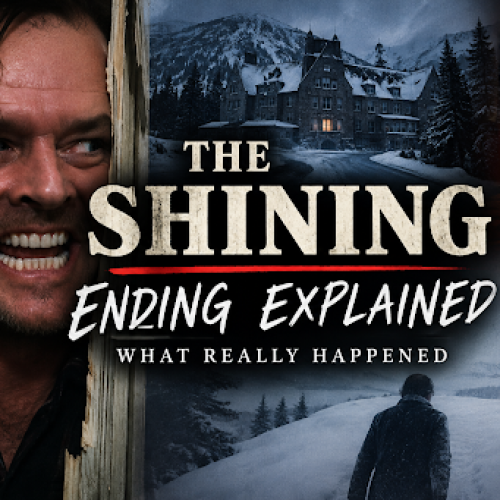
Spoiler warning: this post discusses the full ending of The Shining. If you haven’t seen it, go and watch it first. Then come back and argue with me.
Most horror films end when the monster is beaten. The Shining ends on a photograph. Stanley Kubrick finishes a film full of axes, blood and a hedge maze with a quiet push-in on a framed picture on a hallway wall, and then he cuts to black and leaves the audience to sort it out. More than forty years later, people are still sorting.
Here’s what actually happens, what Kubrick himself said about it, and the theories worth taking seriously — plus a few that aren’t.
What Actually Happens in the Final Minutes
Jack chases Danny into the snowy hedge maze with an axe. Danny doubles back on his own footprints and loses him, then escapes to his mother, and the two of them get away in Dick Hallorann’s snowcat. Jack, lost and exhausted, freezes to death in the maze.
Then the camera drifts back inside the hotel and moves in on a photograph captioned “Overlook Hotel July 4th Ball 1921.” Front and centre in the crowd, smiling, in evening dress, is Jack Torrance. A film set in 1980 has just placed him in a party photo from nearly sixty years earlier.
Kubrick’s Own Answer: Reincarnation
For a film this deliberately opaque, Kubrick was unusually direct about the last shot. Speaking to the French critic Michel Ciment, he said the ballroom photograph suggests the reincarnation of Jack. That’s the closest thing to an official reading we have, and it’s a sensible place to start. It’s also worth noting that, as far as I know, he never said who Jack was reincarnated from, which is exactly the kind of gap he liked to leave.
Theory 1: Jack Is a Reincarnation (and the Grady Problem)
The reincarnation reading gets support from inside the film. Jack tells Wendy the hotel feels familiar, as though he’s been there before. And when the ghostly waiter confronts him, there’s a strange name discrepancy: Jack remembers the previous caretaker who killed his family as Charles Grady, while the man in front of him introduces himself as Delbert. Some viewers read that as evidence that identities at the Overlook repeat and blur, with Jack as the latest man to step into a role the hotel keeps needing filled.
Theory 2: The Overlook Absorbed Him
The second popular reading is less about past lives and more about the building. The Overlook is full of guests who never left, and the photograph suggests it has added Jack to the collection. In this version, Jack didn’t return from 1921; he was claimed by the hotel after he died, his image and his violence kept on the wall alongside everyone else’s. It’s the neatest explanation and the one that sits most comfortably with a conventional ghost story.
Theory 3: He Was Always the Caretaker
The third reading takes Grady at his word. When the ghost insists Jack has always been the caretaker, and that he knows because he has always been there himself, he’s describing something closer to a loop than a haunting. Jack isn’t the hotel’s new victim; he’s the latest turn of a cycle that has been running since long before the film began, and the 1921 photograph is simply proof that he was already in the building. Of the three theories, this is the bleakest, because it removes any sense that Jack could have chosen differently.
The Wilder Theories (Courtesy of Room 237)
No conversation about The Shining is complete without Rodney Ascher’s 2012 documentary Room 237, which is built entirely from voice-over interpretations by obsessive fans. By his own account, Ascher doesn’t necessarily buy any of them, which is probably the healthiest way to approach them. The big ones:
- Native American genocide. The hotel’s decor, the Calumet baking powder cans and the film’s burial-ground backstory are read as a commentary on the destruction of Native American peoples. Of the Room 237 theories, this one has the most visible material to work with.
- The Holocaust. Recurring appearances of the number 42 and the change from room 217 (in King’s novel) to 237 in the film are read as coded references. It leans heavily on small details rather than plot.
- The faked moon landing. The theory that the film is Kubrick’s veiled confession points to Danny’s Apollo 11 jumper and a reading of 237 as the distance to the moon in thousands of miles. StudioBinder notes you have to already believe the moon landing was staged for this one to work, and it wasn’t.
- The Minotaur. Jack as the monster, Danny as Theseus, the hedge maze as the labyrinth. This is the most fun of the lot, and it’s helped by the fact that the maze was Kubrick’s invention; there’s no hedge maze in King’s novel.
None of these explains the photograph, but they explain why we can’t stop looking at the film.
Why End on a Photograph? A Director’s Take
Here’s where I stop being a viewer and start being a director. Kubrick could have ended on Jack’s frozen body, which is the obvious, satisfying beat. Instead, he chose an ending that raises a question rather than answering one. That’s a deliberate trade: you give up catharsis in exchange for an audience that goes home still thinking about your film.
It’s also a very different instinct from King’s novel, where the hotel’s boiler explodes, and the Overlook is destroyed. Kubrick’s hotel survives. The building keeps going, indifferent, and the story stays open. If you’re interested in how withholding information can do more work than showing it, it’s the same principle behind why Jaws still holds up, and it’s a big part of what separates a memorable ending from a merely tidy one. We dig into more examples in our ranking of the best movie endings of all time.
It’s also an ending built on a single, simple image, and that’s a lesson in itself. If you want to understand how those choices get made on a real production, our piece on what a director actually does on set covers the decisions that sit behind a shot like this.
So What Really Happened?
My own read is that the three main theories aren’t really in competition. Kubrick told us the image suggests reincarnation. The hotel’s behaviour suggests a place that collects people. And Grady’s insistence suggests that for the Overlook, time doesn’t work the way it does for the rest of us. Put together, the photograph says the same thing from three angles: Jack didn’t lose to the hotel in one winter. The hotel had been waiting for him, or someone like him, for a very long time.
That ambiguity is the point. If Kubrick had wanted to settle it, he would have. The fact that he gave us just enough to argue about, and then walked away, is the most deliberate directing decision in the entire film.
Want more breakdowns like this? Sign up for the newsletter for the next film deep-dive, or see our guide to movies to watch if you loved The Odyssey for more ambiguous, mythic filmmaking.