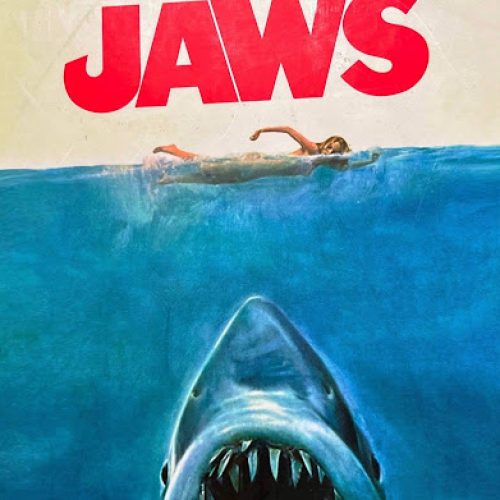
Fifty years after its release, Jaws is still the film most people point to when they want to explain what real suspense looks like. Not jump scares, not gore — dread, built slowly, out of a director who was forced by circumstance to do the harder thing and ended up making a better film because of it.
That’s really the whole story of Jaws as a piece of craft: a young director’s biggest obstacle became his biggest creative asset. Here’s why it still works, half a century later.
The Shark That Wouldn’t Work
The production story is almost as famous as the film itself. Spielberg and his team built three full-scale mechanical sharks, nicknamed Bruce after the director’s lawyer, and none of them was built to withstand actual seawater. Within the first week of shooting on Martha’s Vineyard, the saltwater had corroded the electric motors, and the sharks broke down constantly — sinking, seizing up, needing nightly repairs just to function the next day.
A 26-year-old Spielberg, on just his second theatrical feature, was left with a monster movie and no working monster. His response was the decision that defined the film: instead of waiting for the shark to work, he shot around its absence. POV shots from below the water. The barrels that Quint, Brody, and Hooper attach to track the shark without ever showing it in full. John Williams’ now-iconic two-note theme doing the emotional work the actual creature couldn’t. Spielberg himself later said he had no choice but to figure out how to tell the story without the shark — and that constraint became the film’s defining technique.
Why That Choice Still Matters
This is the part worth studying closely if you’re a filmmaker, not just a fan: withholding the shark isn’t a workaround that happens to still be effective — it’s more effective than showing it would have been. The audience’s imagination fills in something scarier than any rubber shark, mechanical or otherwise, could have delivered. By the time Bruce is finally shown in full for the climax, the tension has been built almost entirely through suggestion, and the payoff lands because of everything the film didn’t show you beforehand.
It’s a lesson modern blockbusters, with essentially unlimited CGI budgets, get wrong constantly. Showing more is not the same as scaring more. Jaws is the clearest possible demonstration that restraint is a technique, not a limitation — and it’s a lesson that only got learned because Spielberg had no other option.
The Human Half of the Film
It’s worth remembering that Jaws isn’t just a monster movie with a clever gimmick — the first half is essentially small-town drama, and it earns the second half because of it. Roy Scheider’s Brody, Richard Dreyfuss’s Hooper, and Robert Shaw’s Quint are given real space to be characters rather than shark-bait, and Quint’s monologue recalling the sinking of the USS Indianapolis remains one of the most quietly devastating scenes in the film — delivered with no music, no shark, just a man remembering something horrific. That scene works precisely because the film has already earned the patience to let a single actor hold the screen for several unbroken minutes.
The Verdict, 50 Years On
Jaws became the first film to cross $100 million domestically and helped invent the modern summer blockbuster as a release strategy. But its box office is the least interesting thing about it today. What holds up is the craft: a director solving an impossible production problem by leaning into suggestion over spectacle, a script that takes time to build real characters before it asks you to fear for them, and a shark that’s scarier for the two-thirds of the film you barely see it.
Watch it again this summer, ideally at night, ideally near water. It still works exactly the way it was designed to.
Enjoyed this one? “Revisiting” is becoming a regular series here — sign up to the newsletter to get the next classic re-watch as soon as it’s up.